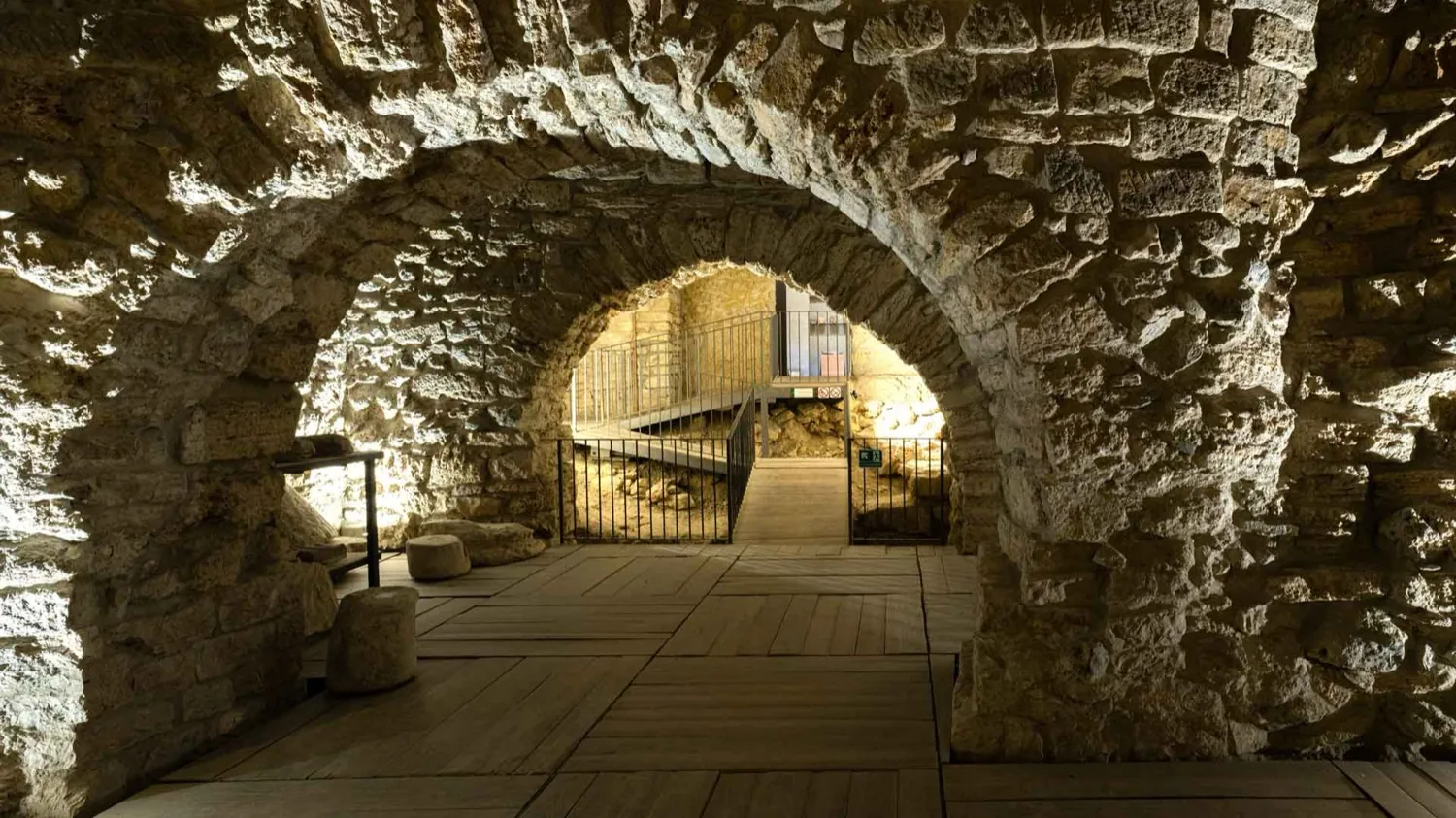
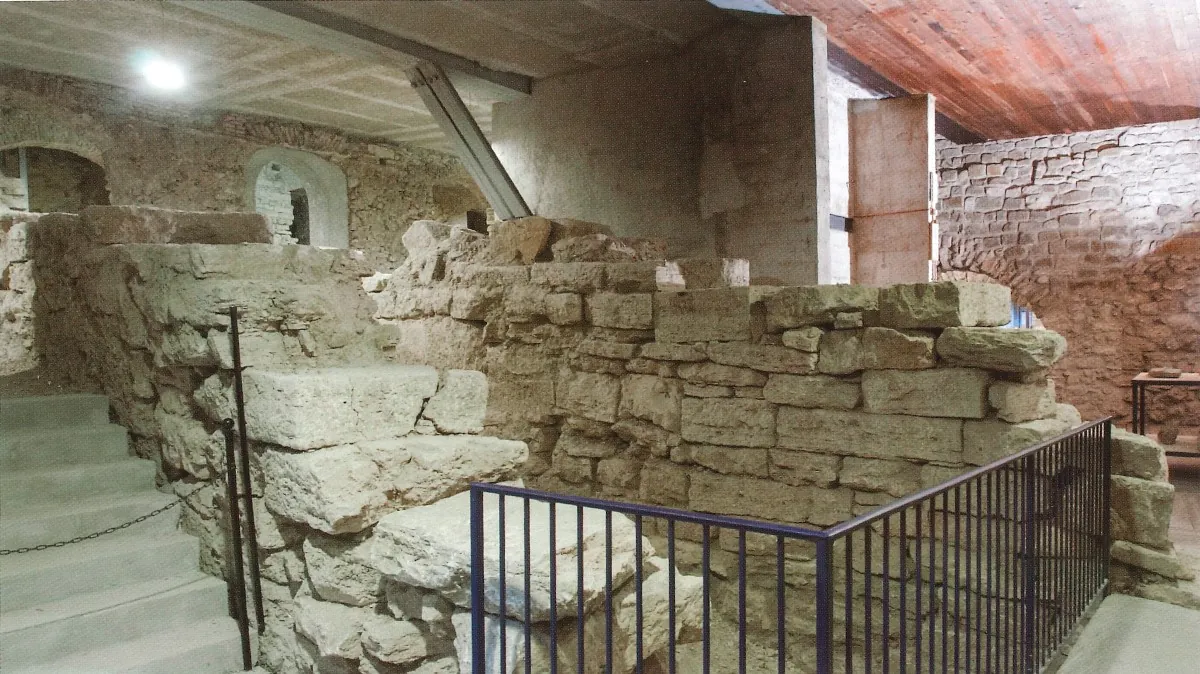
You have just entered the remains of an ancient Roman domus. A domus was the house of a wealthy family – obviously not all Roman families could afford one.
This kind of house had a central room called atrium, in whose ceiling there was an opening called compluvium, through which both sunlight to provide illumination and rain to provide water fell. The latter function gave it its name: compluvium, from Latin cum and pluĕre, i.e. to rain. After falling through this opening, the rain filled the impluvium, a square pool embedded in the floor, that therefore gathered water from the atmosphere. The stone structure you presently see is precisely the impluvium of a domus that once existed all around. The water did not only fill the upper part of the pool, but, by means of a hole dug on the surface of the impluvium, it also filled an underground cistern some 16 feet (5 meters) deep. This big cistern, able to store so much water, strengthens the hypothesis that the domus was owned by a quite rich family, since a Roman familia also included the servants.
One more sign of wealth in this domus can be inferred by taking its position into consideration: it had a privileged location immediately near the decumanus, one of the two main streets.
Archaeological excavations in this area discovered some beautiful plaster fragments. Such decorations have also proved fundamental in order to date the building, that was inhabited in two different epochs.
Both landscapes and architectural elements – such as pillars, pilasters, frames – were painted on the walls. These embellishments, while conveying a sense of elegance, also had a functional end: by reproducing architectural elements, the walls were given perspective, an illusion of depth that seemed to make the rooms more airy. Unlike the atrium, in fact, which was quite big and sunny, the other rooms all around (called cubicola) were relatively small.
More in detail, the plaster surfaces in this domus have been classified by comparing them with the second and fourth Pompeian styles. In Roman painting four styles, generally called Pompeian, have been identified on the basis of the finds in Pompeii, Herculaneum, and Stabia. A German archaeologist, August Mau (1840-1909), was the one who studied the wall paintings in Pompeii and divided them into four periods. His categories do not only apply to Pompeii, they have become a pattern in order to examine all wall paintings of the ancient Roman civilization.
Going back to our domus, its paintings belong to two styles that refer to two distinct epochs. That means that the house was abandoned and destroyed in a certain time, then rebuilt.
The first plaster found in underground Perugia dates back to the second Pompeian style, between 80 B.C. and the late first century A.D. It is called an "architectural" style because architectural elements were painted in lively colors and accurate perspective, making as if they opened the view onto vast spaces outside. This fragment witnesses the first phase, the first "life" of the domus.
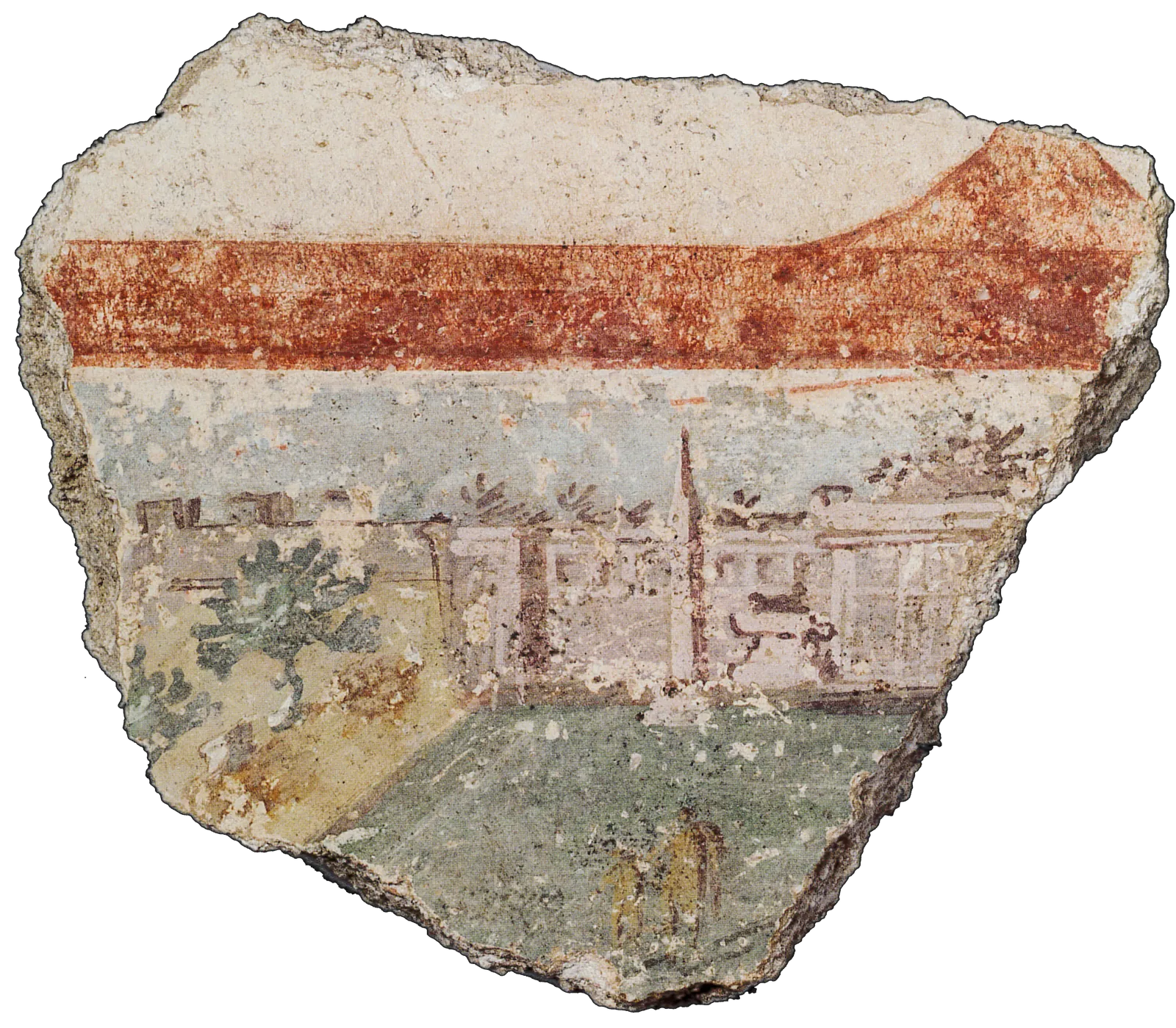
The second fragment shows a white background with a broad red stripe, that bends and makes a point in the upper part; below, a landscape with an architectural wing and a garden is painted. We admire a fine obelisk taller than the building behind it; an altar lies nearby. In the upper part of the altar a sphinx is roughly sketched, just a flat silhouette. The gallery frames a green garden in whose middle two people can be made out, a child and a man. The palette prefers colors like cream, yellow, brown, green, light blue, creating a lively picture. This fragment can be ascribed to the painting in the third/fourth Pompeian style. Our fragment therefore may belong to the first half of the first century A.D. as the second phase of our domus.
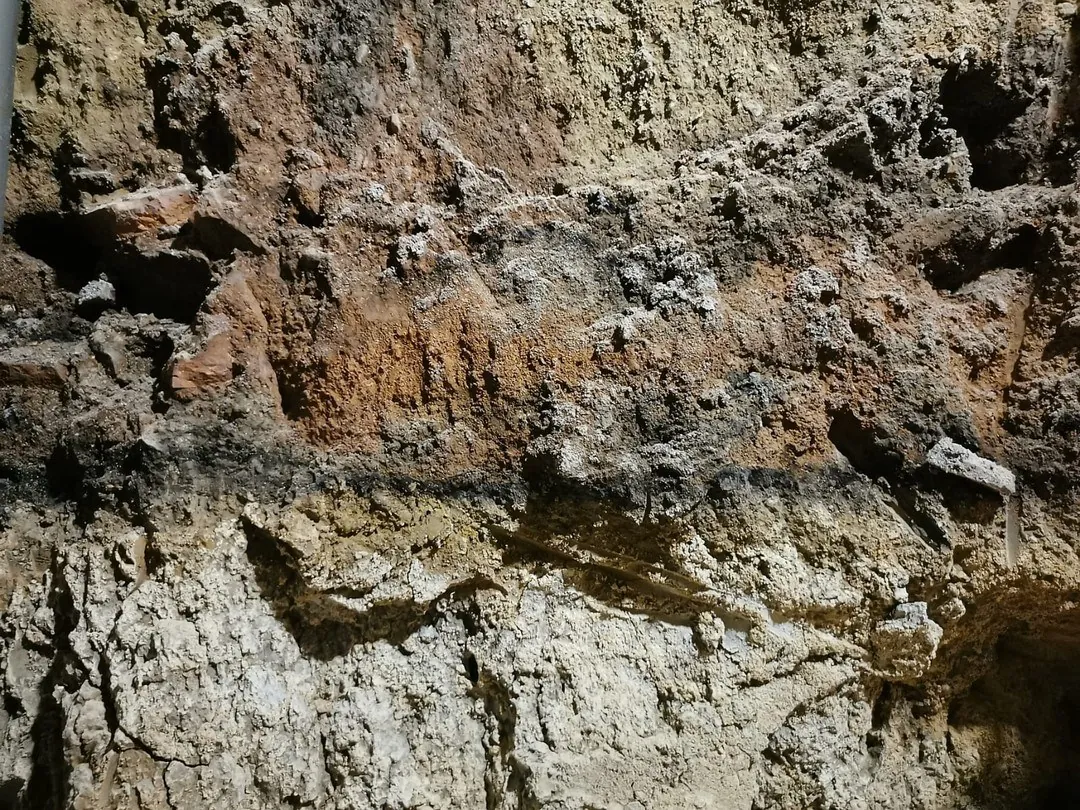
The event that divided the two phases was a fire. All the rooms of the domus, in fact, were filled with a thick layer of burned clay. We think that the fire, causing the house to collapse, should be linked with the "war of Perugia" in the year 40 B.C.
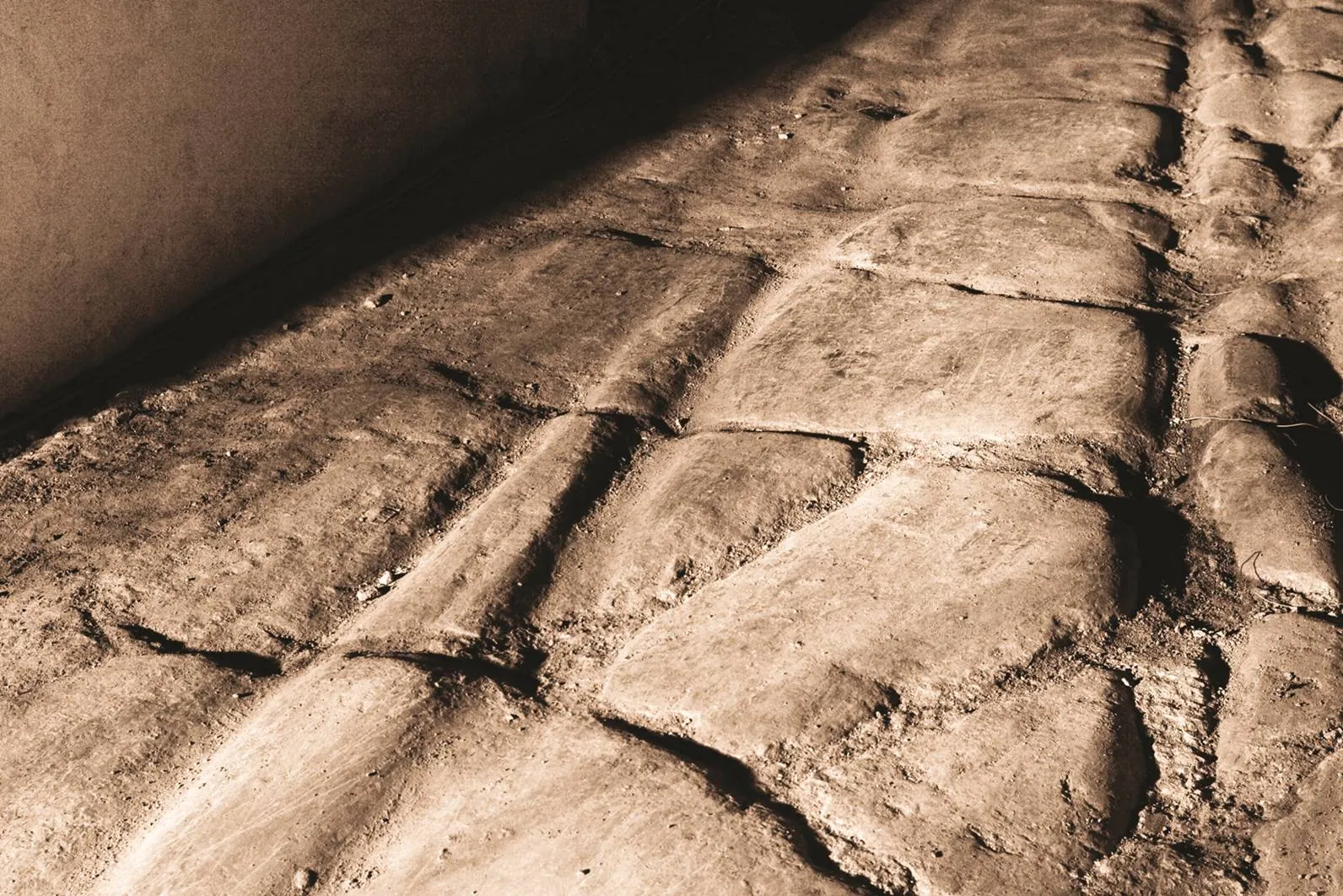
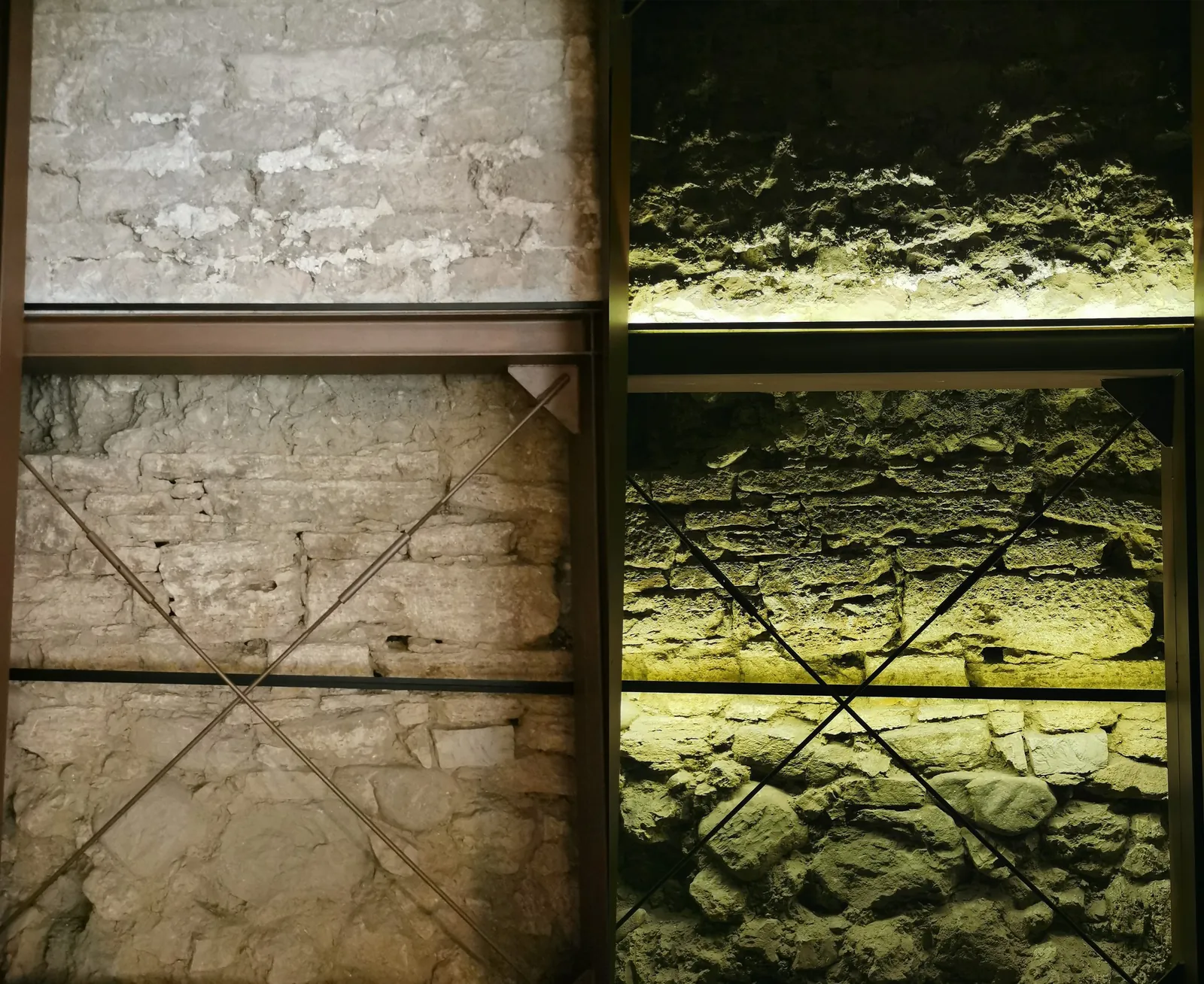
And finally, part of the old inner floor of the domus has been preserved. It was made in a material called cocciopesto (ground bricks). Just above the floor level, on the left, you will see a burned layer (colored in red and black), to be ascribed to the above-mentioned fire.